

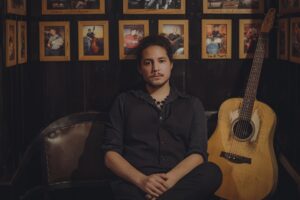
Tim Tercero released his first Solo record „Pinecone Wars“ on September 25th. In an in-depth mail-interview he reflects on the studio process, what he loves about playing live and why he chose an augmented chord in the song Fallen Angels.
Klangskizzerei: Which musician changed your life and how?
Tim Tercero: The first musician to change my life was my uncle, Juan Ortega. He was the one that inspired me to ask my parents for a guitar for Christmas when I was 11 years old. He’s an old-school country singer and rhythm guitarist, and he’s definitely influenced me to include elements of country in my songwriting from time to time.
The second musician to truly affect my style and approach to music has been my longtime collaborator and cellist, Lukas Chytka. He showed me how an instrument can be an extension of oneself and can truly be electrifying. At the beginning of our friendship, I was really making an effort to keep up with him musically. I may never reach his technical level, but through that pursuit, I found my voice and my style, and I am very thankful for that.
What motivated you to write songs when you were young?
I think that my initial motivator was trying to be like the artists and bands that I idolised at that time. This copy cat approach then turned into working through emotions and my own ideas as I got older. I had notebooks full of those texts and scribbles, though nothing ever really happened with them. They were just expressions and little dreams at the time.
I first started presenting my songs when I was around sixteen or seventeen years old with a band I formed with two of my sisters and some friends called “Excuse Me Please.” That was a fun little project, and the songs were playful and mostly about relationships.
Why did you choose the title Pinecone Wars for the album?


Pinecone Wars is a game I played quite often with my siblings and kids from the neighbourhood. You’d play in teams, gather as many pinecones as you could, and then attack by pelting them at each other. It was fun, chaotic, violent, and would often end when someone took it too far and someone else was bleeding or crying. But we played it again and again.
I’ve had the idea of using the title “Pinecone Wars” for a few years, but the songs never really matched it until now. It felt right to call this album Pinecone Wars because of the woody acoustic approach and the simplicity of the song arrangements.
What lyrical themes do the songs on the album cover?
Lyrically, I would say that this album has a decent range of topics. “Pinecone Wars” and, similarly, “Snake Skin Oil,” deal with the exploration of the resurgence of nationalism and the romanticism of war. “Two Hand Touch” is about a blooming romance between football players (American football). “Trouble is Up” is a reflection on the long-distance relationship that brought me over to Austria and “Trace of Dust” deals with the grief of losing a parent. There are then three songs about relationship struggles including “Hey Dilly Dally,” “What Goes Round,” and “Sugar Coat,” and finally a song about angels on the run from a tyrannical Heavenly Host in “Fallen Angels.”
There’s a bit of variation in the inspirations and themes of the songs, but there was no real plan to keep the album with any sort of a red line.
On your website, it says you experimented with simplifying your songwriting for this record. How did you approach that?
I’ve had a project called The L.L.A. that’s been active since 2019. It’s also a solo project, but the approach is more heady and strategic. It has been fun, but the song arrangements are always a bit more experimental and usually go through a lot of revisions. Sometimes the process can get a bit tedious.
When I decided to go for an acoustic project in late 2024, I flipped a switch, and these songs just started flowing. It was a trickle at first, but last fall, I wrote four of the songs that made it onto the album in one month.
I think the ease with which these songs were written came from the knowledge that I wasn’t going to mess with them much, because I wanted to write songs that would feel good stripped down to just an acoustic guitar and a voice, and so far, I’ve felt pretty good about them when performing alone.

How did you write the song “Trouble is Up”?
“Trouble is Up” is one of the oldest songs on the album. My inspirations were the feelings and memories I had while I was in the long-distance relationship that brought me to Austria.
The writing process was a bit closer to the one that I would use with The L.L.A., e.g., I did a lot of the writing and experimenting on my own. There’s a piano part and an Fx drenched guitar part that we kept for the final version on the album. Michi also kept his drum arrangement similar to the demo drums, and Ines started from a similar place with the vocal harmonies. Of course things evolve with each new character and with the recording process in the studio, but this song stayed pretty close to the demo version.
What was important to you regarding the arrangements on the album?
Besides “Trouble is Up” and “Fallen Angels,” which were produced and arranged mostly on my own, it was important for me to keep things simple and organic.
Lukas and I would jam over the songs and make little notes of ideas we thought were fitting and exciting. I would do the same with Ines and then with Michael. We then rehearsed the cello, drums, and guitar parts for the studio because we were going to record them live. That’s where the magic started to truly feel real. Tweaks were made, but we made sure that the arrangements felt authentic to each individual before pressing the record button.
How did the musicians who play on the record shape the album?
I kind of touched on this in the previous answer, but I would also say that, even though it’s a project under my name, I wanted to make sure every musician felt inspired and invested in their part and had a creative outlet in the album as well. When I met with each musician individually, I always gave them space to present their ideas and visions for the song. We mostly kept the lyrical arrangements, and they added their fingerprints to the instrumental arrangements.
How did the drum parts come together? Did you have a clear vision in mind, or was it a collaborative process with drummer Michael Lind?
The only two songs that had some pre-made production were “Trouble is Up” and “Fallen Angels,” the other seven songs were shaped by Michael’s own inspiration and input.
We jammed over them in the rehearsal space and discussed any parts that had question marks, so it was very collaborative. But the drum arrangements really came from his experience and creative vision. The drums were the final addition to the songs, and I had nothing but big smiles when I heard the final pieces put into place.
The record, to me, lives in a certain niche of playfulness and handmadeness. How did you try to capture that organic vibe in the studio?
This was really my favourite part of the process. Seven of the nine songs were rhythmically recorded live. Lukas and Michael played together in the main studio room. Lukas was on electric cello, so there wasn’t an issue with bleed-through between the cello and the drums. I was in a separate room but had a visual connection to them.
We then performed each song a few times until we got “The Take.” It was usually the third or fourth take, but there was no rush. That was a wonderful experience for me.
We went into these recordings knowing there would be some imperfections, a few speed-ups or slow-downs, but that’s what makes it so human, playful, and old-school. That’s how I want to continue making albums in the future.
How did you write the song “Fallen Angels”?
Similar to “Trouble is Up,” I did a lot of the pre-production for this one on my own. The piano and guitar/bass leads were born out of experimenting. I had a visual in my head of road-tripping down Highway 1 on the West Coast of the US when writing the lyrics. This idea then turned into angels on the run from that aforementioned tyrannical Heavenly Host. I really liked that twist, and I still imagine the visual when performing it live.

It’s got a nice augmented chord acting as a transition to the F chord in the verse. Is that something you’ve used in previous songs, or is it more reserved for the occasion?
I haven’t used that chord in any other song, but it just came out of quietly jamming by myself. It had a nice feeling to me.
Later, I found that it reminded me of the chord progression and interval in the intro of “Mamma Mia” by ABBA, which is probably why I liked it so much. But I kept it in the song anyway. “Mamma Mia” is a good road-tripping song, so it made sense that it should somehow accompany my own road-tripping ballad.
How did you perceive the reactions to the album release show at the Spektakel?
The release show was an incredible experience for me and the rest of the band. The audience was so respectful and attentive. The feeling on stage was comfortable and magical, thanks to the sound and thanks to the stage design by Peter Wieser.
We made a stage-background switch in the second set, which brought such a new energy into the room. There were times when people in the audience gave audible cheers of excitement during our performance, when the dynamic build and tension hit in the right way. That felt like a pure shot of dopamine for me.
The feedback from friends and audience members after getting off stage was such a blessing. We worked on this album for two years and promoted the release show for six months. To walk off stage and receive smiles, hugs, and comments about how much people enjoyed it was a dream come true.
What do you love about playing live?
I think there are two aspects to my love of performing, especially with this project.
The first is being on stage with musicians I respect and love. The fact that we’re putting all this effort into creating our own unique expression through these songs is incredible for me. We’re not aiming to be perfect and are ok if the song goes in slightly different directions with each performance. It should be something unique to that stage, that audience, and how we’re feeling that evening. Those differences make it exciting and human.
I’ve been in projects where so much effort went into being perfect and cool and “in,” and that just sucked most of the fun out of it. After a while, it started feeling pretty fake. So the aim is to strive to be as good as we can while giving the human element more space and truly connecting with each other as we play these songs.
My favourite moment from the release show was performing our song “Streets of Gold,” which was meant to be without drums. But during soundcheck, we discussed it and thought it could be cool if Michael played along. We had one run-through, and it worked great. Anyway, he played it differently during the performance, but that was perfect. The build, his own interpretation of the music, and those surprises (for me) made it bigger and better than I could have hoped for. It was a beautiful moment for me.
The second love, of course, is connecting with the crowd. I love talking with the audience, telling little impromptu jokes, and making a connection. That’s why the release show was so special for me. There was attention and space. I could talk to my son, tell the story of each band member and how we met, and talk about the songs. There was even one wonderful audience member who would respond to certain things in a conversational style, and that was so funny and joyful.
So I guess my love for the band and the audience is similar in that it’s all about finding genuine connection on stage and off of it.
Thank you for the interview!

If you like Tim Tercero’s music follow him on instagram and buy the album on bandcamp
If you want to read more interviews with austrian musicians follow klangskizzerei on instagram or sign-up for the newsletter below.

Gitarrenmusik und Konzertskizzen